Juliane Laitzsch
7.5. – 20.7.2025
Eröffnung: 6.5. um 19 Uhr
GOTHISCHES HAUS, Berlin
Breite Straße 32
13597 Berlin
Montag-Samstag 10 – 18 Uhr
Sonntag 12 – 18 Uhr
An Feiertagen geschlossen
Veranstaltung: 26.Juni 18:30
der ehemalige Stadtkonservator Andreas Kalesse führt durch das Haus, als Zeitzeuge einer aufregenden Restaurierung.
Bildmaterial zur Ausstellung findet sich hier
Images relating to the exhibition can be found here
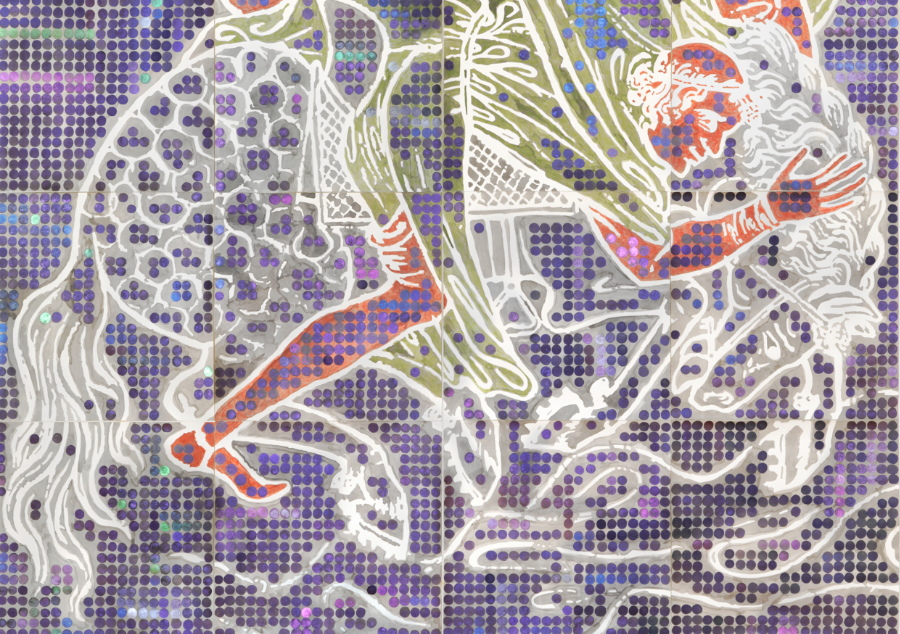
Detail: Über Wasser galoppieren, nach einem Motiv von Villard de Honnecourt, Bauhüttenbuch (ca.1230), Tafel 6 · Buntstift, Aquarell auf Papier · 24-teilig, insgesamt 336 x 224 cm · 2025 · Foto: Bernd Borchardt
//For English please scroll down.
Die wissenschaftliche Recherche, das Sehen, Lesen und Rezipieren von Archivalien sind die Ausgangspunkte der künstlerischen Praxis von Juliane Laitzsch (geb. 1964). In der Ausstellung Über Wasser galoppieren zeigt sie Arbeiten auf Papier und skulpturale Interventionen im Gotischen Haus, dem ältesten Bürgerhaus im gesamten Berliner Raum und hinterfragt zeichnerisch unterschiedliche Blickwinkel auf dessen bewegte Historie.
Der Ausstellungsort dient als thematische Quelle. Dabei richtet sich ihr Augenmerk auf marginale Details der Baugeschichte. Anträge zur Anbringung von Werbetafeln interessieren sie ebenso wie die zahlreichen Vorschläge zur Benennung des Gotischen Hauses. Sie kopiert den Bericht zur Bauforschung des Hauses, Details aus Architekturplänen oder das Foto einer Zeichnung des Gewölberaumes um 1900, die vermutlich in den 1940er Jahren, nach einer heute verschollenen Postkarte entstanden ist. Zwischen diesen Schichten von Medien und Zeitlichkeit, zwischen Original und Abbild sucht Juliane Laitzsch künstlerisch die Nähe der Menschen, deren Spuren sie folgt.
Die Zeichnung dient ihr dabei als ein Medium der Verlangsamung und der Annäherung. Als Metapher dafür, dass unser Wissen über Geschichte – unsere Vergangenheit – fragmentarisch und unsicher bleibt, greift sie eine Zeichnung aus dem gotischen Bauhüttenbuch von Villard de Honnecourt auf – ein über Wasser galoppierendes Pferd. Ergänzt werden die zeichnerischen Arbeiten durch Skulpturen, die mit der aktuellen Architektur der Räume korrespondieren. Juliane Laitzsch thematisiert in ihrer Arbeit Wandel und Veränderung – den Fluss der Zeit, vor dem Hintergrund, dass wir alle irgendwann vom Pferd fallen.
Einführung: Dr. Jens-Ole Rey, Künstlerischer Leiter
Scientific research, as well as viewing, reading, and engaging with archival materials, are the starting points of Juliane Laitzsch’s (b. 1964) artistic practice. In the exhibition Über Wasser galoppieren (Galloping Over Water), she presents works on paper and sculptural interventions in the Gotisches Haus, the oldest surviving townhouse in the entire Berlin region, exploring through drawing the various perspectives on its eventful history.
The exhibition venue serves as a thematic source. Her attention is drawn to marginal details of the building’s history. Applications for the installation of advertising panels interest her just as much as the numerous proposals for naming the Gotisches Haus. She copies the building research report on the house, details from architectural plans, or the photograph of a drawing of the vaulted room around 1900 — presumably made in the 1940s after a postcard that is now lost. Between these layers of media and temporality, between original and reproduction, Juliane Laitzsch seeks, through her art, closeness to the people whose traces she follows.
For her, drawing is a medium of slowness and approach — a way of drawing near. As a metaphor for the fact that our knowledge of history, of our own past, remains fragmentary and uncertain, she returns to a drawing from Villard de Honnecourt’s Gothic workshop notebook: a horse galloping over water. These drawn works are joined by sculptures that engage in dialogue with the rooms‘ present-day architecture. Throughout, Laitzsch’s work circles around transformation and change — the flow of time — set against the simple truth that we all eventually fall from the horse. Introduction: Dr. Jens-Ole Rey, Artistic Director